
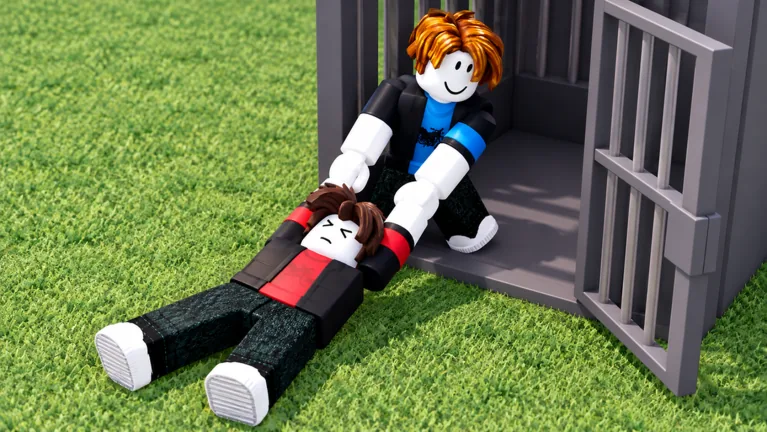
Meet the delivery route before it reaches the cage
When an enemy is transporting your teammate, move with support to contest the route toward their jail. Look ahead to a reachable crossing or approach instead of chasing from far behind. The aim is to prevent an uncontested delivery and keep your ally’s escape route in view.
This is an earlier intervention than a jail rescue. You are dealing with a moving carrier, often with an escort nearby, rather than a prisoner already behind bars. Decide which situation you are facing before committing to the wrong target.
Identify the carrier and the destination
Use team colors and the visible carried opponent to recognize the delivery. Then look at the direction the carrier is taking. An enemy running past you is not automatically transporting somebody.
Find the next place where you and an ally can challenge their route. A narrow crossing or the approach to their base can be easier to read than a chase through unrelated fights, provided you can reach it without isolating yourself.
Do not wait at a distant point the carrier will never pass. Keep watching their movement and adjust when the route changes.
Challenge the route with support
Keep the carrier in view as you respond to these situations:
| Situation | Your priority |
|---|---|
| Carrier approaching with no nearby escort | Contest the route while watching your ally |
| Escort moves toward you | Keep a teammate involved so the carrier is not ignored |
| Carrier turns onto another route | Reposition toward the new approach |
| Your support falls behind | Regroup before chasing deep into the enemy base |
| Opponent reaches jail | Change to an outside rescue plan |
Pressure the carrier where your team can follow up. If the escort pulls you into a long side fight, check whether the delivery is continuing behind you. Winning that side fight after the prisoner reaches jail does not solve the original problem.
Use a short call identifying the route and carried teammate. It gives nearby allies a reason to join the interception rather than assume you are starting another random duel.
Watch the carried state after contact
Do not build the plan around a supposed universal single-hit release. After an attack or ability interaction, watch whether the carrier still has your teammate and what the teammate can actually do.
If the carried state changes and your ally can move away, help cover their retreat toward friendly support. If the carrier continues, reassess the route and available help. Choose your next move from what happens on screen.
Stay where you can retreat toward your team. An interception that leaves both rescuers isolated beside the enemy base can add another capture problem even while the original transport is being contested.
Know when to switch tasks
If the carrier completes the delivery, stop treating the moving route as the main target. Locate the cage, gather support and coordinate pressure on a bar section with the prisoner.
If the ally gets away, regroup and check the team’s current pressure. You can escort them back toward support or help the nearest threatened jail. There is no need to continue chasing the former carrier across the whole arena.
Use rescuing teammates once the opponent is behind bars. The outnumbered guide helps when too few allies remain available to contest every delivery.
FAQ
Is interception the same as breaking somebody out of jail?
No. Interception contests the transport before delivery. A jail rescue deals with a prisoner already inside the cage.
Does one hit always force the carrier to drop my teammate?
Watch the actual carried state after contact. Do not rely on an assumed universal release rule when planning the follow-up.
Should I chase the escort instead?
Keep the delivery in view. If you pressure the escort, coordinate another teammate to watch the carrier rather than letting the transport continue untouched.
What if the carrier reaches jail first?
Switch to an outside rescue plan. Regroup, coordinate bar pressure with the prisoner and prepare an exit away from the cage.